
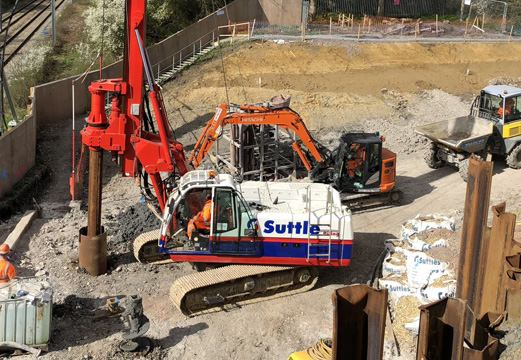
Piling may not be the most glamorous aspect of building design and construction, yet it’s often a fundamentally important project enabler. The right piling method allows significant infrastructure and larger buildings to be created without a corresponding increase in the scale and complexity of the foundations.
Piling can also allow building on ground that would otherwise be unsuitable. And it often forms an integral part of temporary works that allow projects to proceed safely and cost-effectively.
Different piling methods suit different geologies and applications. Self-delivery capabilities that span all major techniques ensure that Suttle Piling can deploy the most suitable method in all circumstances.
From our point of view, there’s nothing boring about piling, even if it does sometimes feature boring.
Driven Piles
Based on what they’ve seen, and more likely heard, somebody outside the industry would probably assume that piling means piles driven into the ground. This is still a widely used method with piles being timber (usually in coastal locations), reinforced concrete, or steel in either tubular, box or H sections.
Driven piles can also be in the form of interlocking sheets, which are typically used where soil or water has to be retained either temporarily or permanently. Sheet piles are sometimes combined with structural ties such as Anker Schroeder anchors combined into a fabricated waler system for retaining structures such as quay walls, abutments, berths and crane runways, as in the case of the Portland deep water berth.
Driven piles are proven and effective. The main drawbacks are noise and vibration, which makes the technique unsuitable for many locations such as built-up areas. It’s also not the most efficient or suitable method where there are significant obstructions in the sub soil.
Bored Piling
Bored piling is highly versatile in terms of location and soil conditions and is often used for supporting large structures such as bridges or in coastal schemes. In its simplest form, large holes are drilled in the ground and filled with concrete – perhaps with a reinforcing concrete cage – to transfer building loads to deep-lying stable soil or rock layers.
Rotary bored piling is typically used where there are obstructions such as rock within the soil. A temporary steel casing is inserted as the hole is bored. The rock and spoil is removed from inside the casing which is then filled by inserting a reinforcing steel cage and pouring in concrete.
CFA Piling
Continuous Flight Auger (CFA) piling is a highly versatile refinement of standard bored piling. It uses an auger with a hollow stem that allows concrete to be pumped into the bore hole as the auger is withdrawn. A steel reinforcing cage is then inserted into the wet concrete.
CFA is the most commonly used piling method in the UK. Removing the need for casings and temporary support results in an efficient, continuous process. It suits a wide variety of soil conditions and can create piles from 300mm to over a metre wide to a depth of 32 metres.
The business has invested heavily in specialist piling equipment so we can deliver reliably and efficiently, even in the most challenging ground conditions and access-constrained sites.
Suttle Piling’s Integrated Capability
Suttle Piling brings certainty and simplicity to ground engineering projects by combining a substantial, self-operated fleet of piling rigs, specialist plant and support equipment with in-house design expertise. Our engineers and designers work directly with our delivery teams, allowing us to select and refine the most appropriate technique – whether driven, bored, rotary bored or CFA – based on real site conditions rather than theoretical assumptions.
At design stage we consider multiple factors, including ground conditions and stability, ground water, potential obstructions, contamination and access constraints, then develop detailed designs that specify the optimum piling method, layout and details. This joined-up approach means we can switch methods where necessary, optimise sequences and interfaces, and produce final designs that simplify follow-on operations and future maintenance.
By doing the detailed analysis up front and tightly integrating design with delivery, we keep projects on programme and on budget and take responsibility for project and commercial risks, including precise material quantities.
For more information on how we can help you make the right ground engineering choices’ please contact [email protected]