
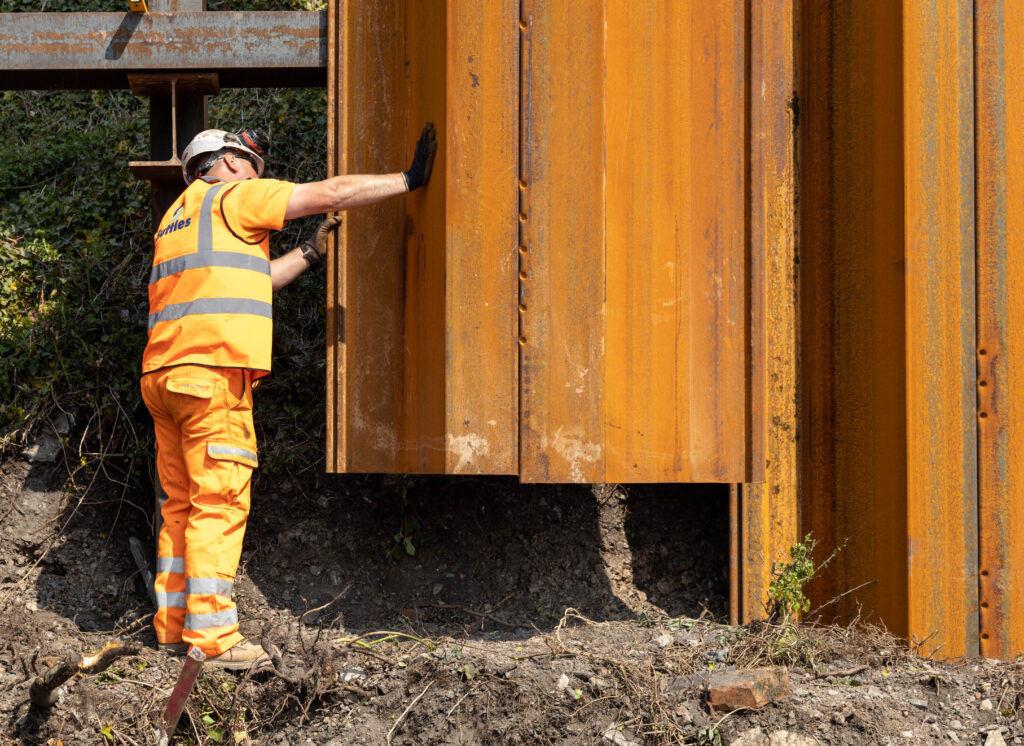
Sheet piling is an established and versatile technique for retaining soil or water in temporary or permanent works. Temporary works applications include cofferdams and excavation protection, which allow projects to proceed safely even where there is unstable ground or significant groundwater that has to be managed.
Permanent applications include stabilising rail or highways embankments and coastal erosion protection. Because there’s less need for excavation, sheet piling is generally quicker and less disruptive than constructing concrete retaining walls. This often makes it ideal for emergency embankment stabilisation.
Sheet Piling: The Basics
The principle is fairly simple: lengths of interlocking U or Z profile steel sheets are driven into the ground to form a continuous wall. The joints between the piles can be sealed if additional water resistance is needed and the piles can be pre-coated for longer-term corrosion protection.
In some circumstances, backfilling the piled wall with reinforced concrete provides additional long-term stability. This is a common approach for areas that are affected by coastal erosion as in this case where a 60m sheet piled wall was installed and backfilled with fibre reinforced concrete to provide an additional 50 years of erosion protection.
In coastal locations, sheet piles can offer deep-level stability to prevent seawalls and promenades from being undermined. At Stokes Bay, Suttle Piling repaired failing sea defences by installing 135m of 10m sheet piles that were then capped with reinforced concrete to create a new seawall and promenade.
Installation Options
Once sheet piling is identified as the preferred method there are still decisions to be made regarding the installation method and pile depth. These will be influenced by factors such as ground conditions, site access and the sensitivity of the site to noise, vibration and disruption.
Sub-soil conditions may determine the maximum pile depth that is possible and whether anchors will be needed to provide additional stability. Sheet piles can be installed using vibratory hammers, impact hammers, hydraulic presses or silent pressing techniques. Pre-auguring or water jetting may be used to assist installation in dense soils.
Having an extensive range of piling equipment and in-house geotechnical expertise allows Suttle Piling to quickly identify and deploy the most appropriate solution.
Sheet piling is just one of a wide range of piling methods deployed by Suttle Piling to simplify ground engineering by matching the ideal method to each situation.
To find out more, contact Suttle Piling