
The complexities of the sectors we work in are likely to mean a piling project will be affected by constrained access, unstable ground, flooding, watercourses, tides or maybe a combination of those factors. There might also be overhead or underground obstructions to contend with.
Site complexity is all in a day’s work for our project teams.
Piling in Marine Environments
Sometimes difficult access means no access – at least from the land. Marine environments present some of the biggest challenges.
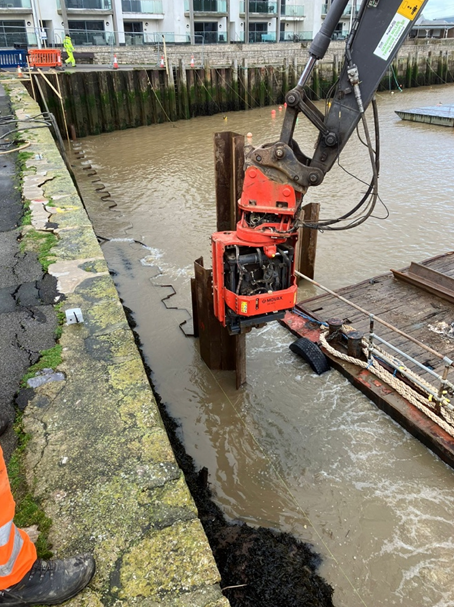
When Suttle Piling was commissioned to install 50m of sheet piling to stabilise the harbour wall at West Bay, this had to be done from the water, owing to restricted land access and the need to protect the local marine environment. A JML60 Deck Cargo Barge provided a stable floating working platform to allow the piles to be installed efficiently with minimum disruption to habour users.
Piling Installation in Live Environments
Working close to a live railway – perhaps in a hard to access location – is far from unusual. A complex piling and retaining wall package formed part of the construction of new railway overbridge abutments at the A419 White Hart Junction. The scope included 28 rotary bored piles, and a wall comprising 32 kingposts.
Comprehensive planning and collaboration with stakeholders ensured that all works could be undertaken safely, maintaining the highest standards of safety and operational control throughout the project.
As site conditions evolved, the team adapted both the permanent and temporary works solutions, including additional sheet piling to support the access road and piling platform. These changes were implemented without affecting the schedule.
Piling Versatility Brings Flexibility
Sometimes, flexibility comes from the choice of equipment available to our project teams. This flexibility can reduce how much machinery is needed on site – often vital in sensitive or constrained locations.
When repairing the damaged seawall at Stokes Bay, the team installed 135m of 10m sheet piles, using a 50t Komatsu PC490 excavator and Movax attachments that included SG75 side grip and DH25 impact hammer.
The piling equipment choice handled all excavation work as well as the initial demolition of the damaged seawall, eliminating the need for additional machinery on site. The Movax system also accommodated two different piling techniques: side-grip pile driving and impact hammering for back-driving the piles, making the whole project much less obtrusive and disruptive.
However challenging the site, our teams are proud of the fact that they still manage to simplify ground engineering projects through careful planning, creative problem solving and equipment flexibility.
To find out more, contact Suttle Piling,