
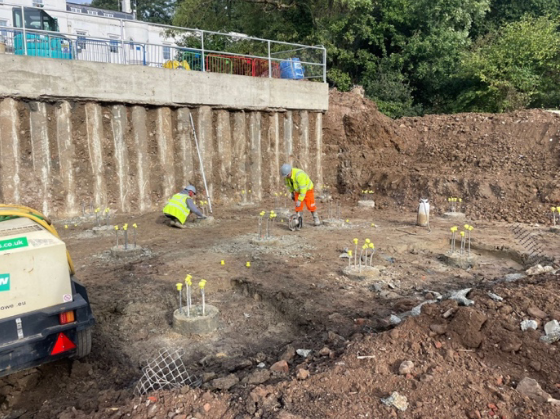
Augered piling is a commonly used method in modern construction. The low noise and vibration levels make Continuous Flight Auger (CFA) and Sectional Flight Auger (SFA) piling suitable for many locations and applications including urban sites, hospitals, schools and residential areas.
Typical CFA piles range from 300 mm to 1200 mm in diameter and can reach depths of 30 metres or beyond with specialised equipment. CFA and SFA methods also suit a wide range of ground conditions.
CFA, SFA - What’s The Difference?
As the names imply, augers can either have a single continuous shaft or – for SFA – be gradually extended in sections as the bore hole goes deeper. SFA is a little more complex and tends to be used where there are height restrictions or overhead obstructions that would make it unsafe or impractical to use CFA.
It’s not unusual to mix both methods within a single project. For example, while installing piles to support station enhancements at Okehampton, operational constraints meant that SFA was used for the south-side trackside location while CFA was deployed for the north side of the site.
How Does CFA Differ From Rotary Bored Piling?
As CFA, SFA and rotary bored piling all construct piles by boring a vertical hole and filling it with concrete there are obviously many similarities between the methods.
The key difference is that with CFA and SFA the concrete that forms the pile is poured through the hollow core of the auger as it is withdrawn. With rotary bored piles the concrete is poured after the drilling head and shaft are withdrawn. Spoil is continuously removed behind the drilling head and a steel reinforcing structure is usually inserted into the bore hole before the concrete is poured to complete the pile.
CFA - A Digital Future?
With such an established and widespread piling method it’s maybe tempting to think that the scope for technological development is limited. But there are interesting developments around making more use of the data that has routinely been recorded during piling operations for many years.
Torque, penetration resistance and rotary drive pressure have the potential to tell us more about precise below-ground conditions. The data could be analysed and interpreted in real time using machine learning techniques, which could help optimise pile depths to speed up projects and reduce material use.
CFA and SFA are options in a complete range of piling methods used by Suttle Piling to simplify ground engineering by matching the ideal method to each situation.
To find out more, contact Suttle Piling.