
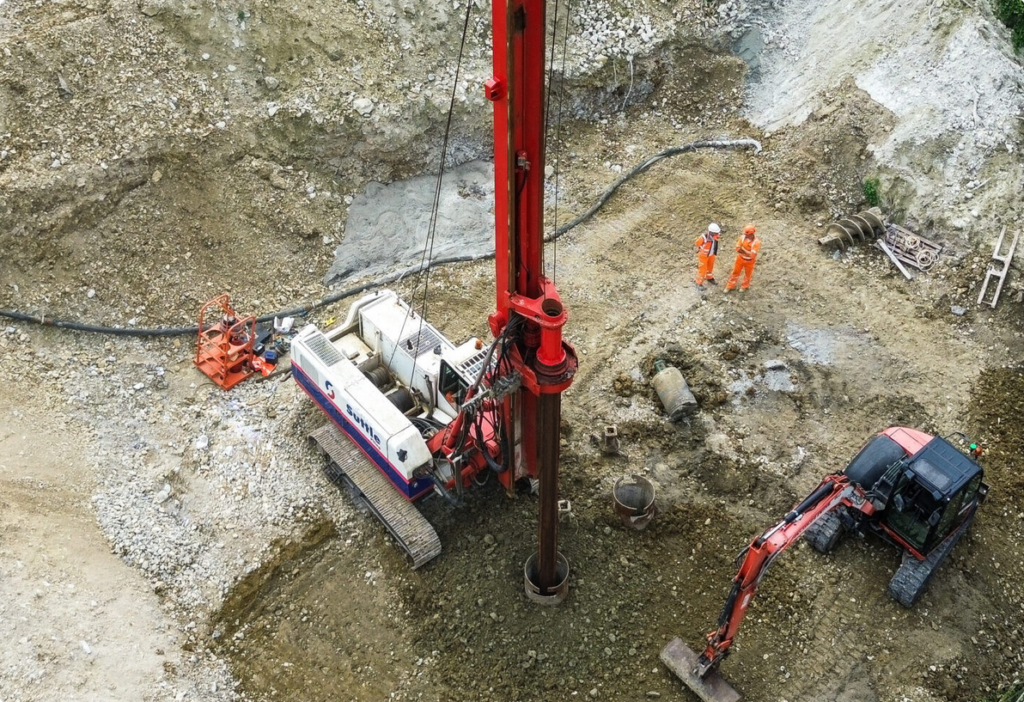
Rotary bored piling is a highly versatile low-vibration piling method that can install wide, deep piles through almost any type of ground. It’s ideal for creating foundations for substantial structures that would be beyond the capabilities of Continuous Flight Auger (CFA) methods. Piles can be deeper than 60m and up to 1.8m wide.
Where ground conditions feature a high moisture content, rock, cohesive soils, or highly granular materials, rotary bored piling is usually the most suitable method. To understand why, it’s helpful to explore how the technique works and how it’s different from CFA piling.
With the rotary method, bores are excavated by a drilling head attached to the mast of a large high-powered rig. As the borehole is drilled, spoil is continuously removed using buckets or augers or by flushing with a drilling fluid.
Unstable Ground Conditions
When drilling through unstable ground – perhaps because of the presence of water or loose materials – a temporary or permanent casing allows the pile to be bored without collapsing the ground. If the ground is unstable throughout the length of the pile, a full depth casing or a polymer-based drilling fluid can be used to provide stability and keep the borehole open.
Once the borehole is complete, a steel reinforcing structure is inserted before concrete is poured to complete the pile. If a temporary casing is used, this is progressively withdrawn as the concrete is poured.
CFA, on the other hand, uses an auger to bore the pile to the required depth and concrete is injected through the hollow stem of the auger as it is withdrawn. Steel reinforcement is normally inserted into the concrete before it sets.
More Options
The scale of the piles that can be created with the rotary bored method and the range of sub-surface ground conditions it can accommodate offer designers plenty of options. It’s also a useful technique where substantial supporting piles need to be installed with minimal impact on the local environment, as with the access bridge needed to facilitate the extension of the Swanworth Quarry.
Are there potential drawbacks? Boring piles of this depth and diameter obviously creates a lot of spoil, which needs to be accommodated in the project plan. Care also has to be taken to avoid contaminating groundwater. Finally, the large-scale piling equipment may not be suitable for constrained sites or where there are overhead obstructions.
Rotary bored piling is just one of a wide range of piling methods deployed by Suttle Piling to simplify ground engineering by matching the ideal method to each situation. See more projects here: Rotary – Suttle Piling
Please contact Suttle Piling to find out more.